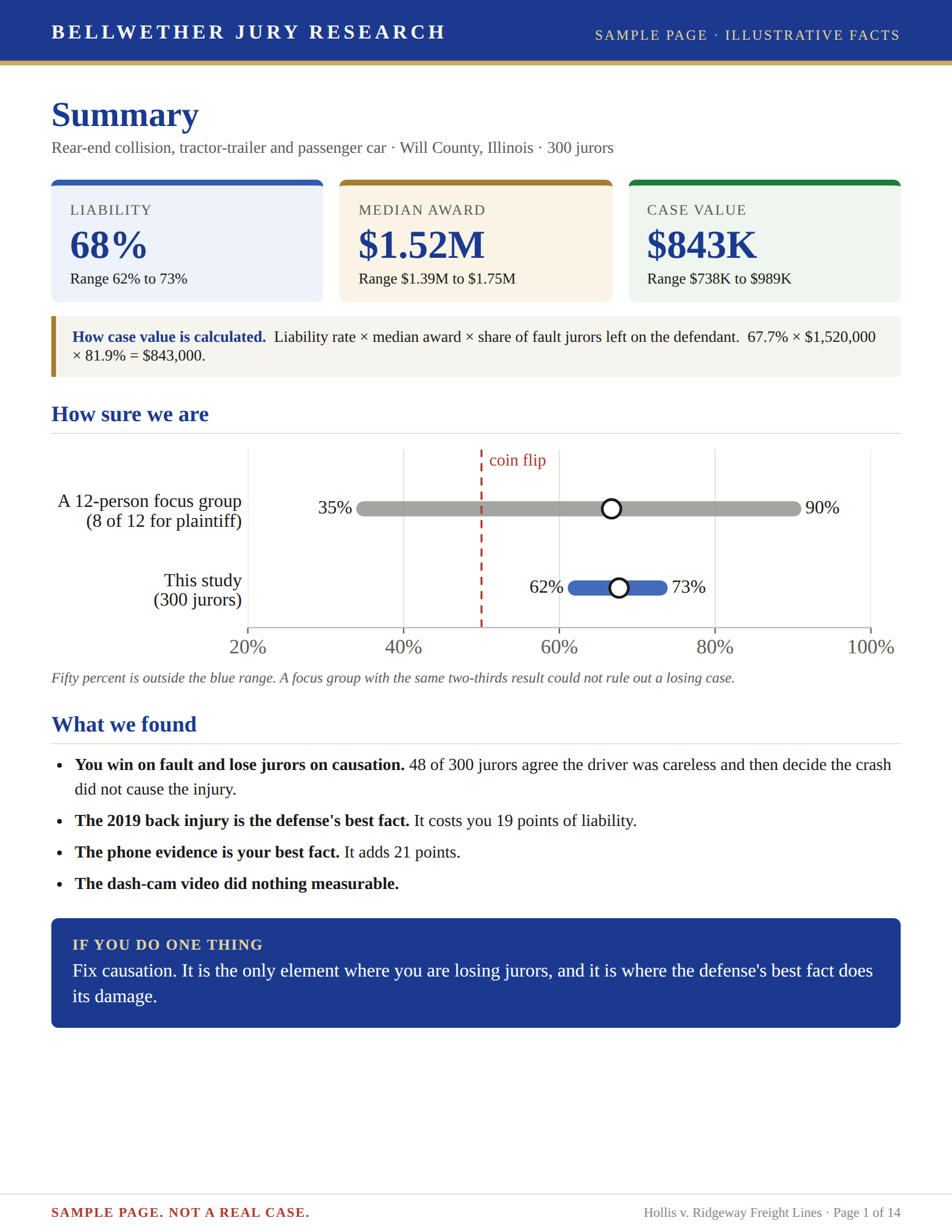
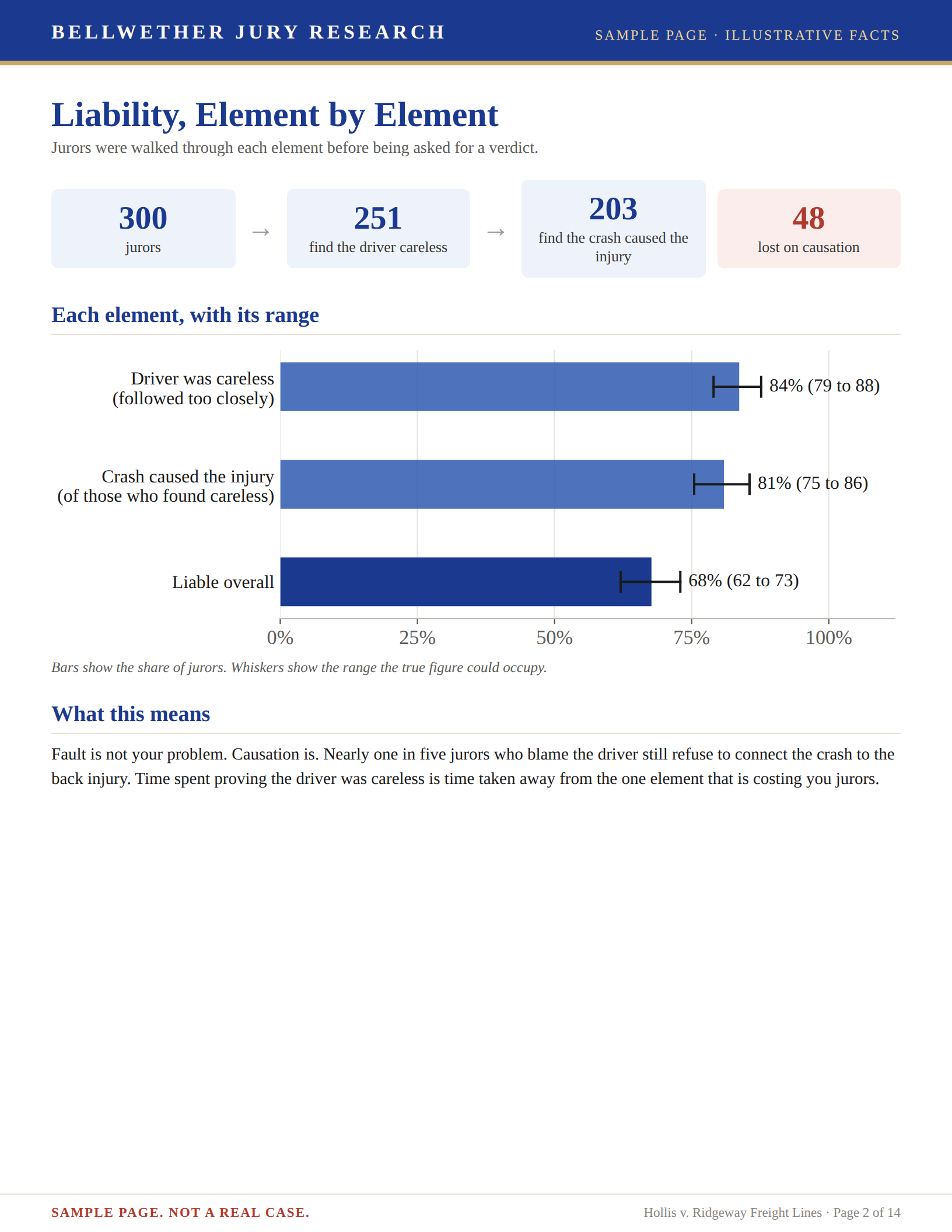
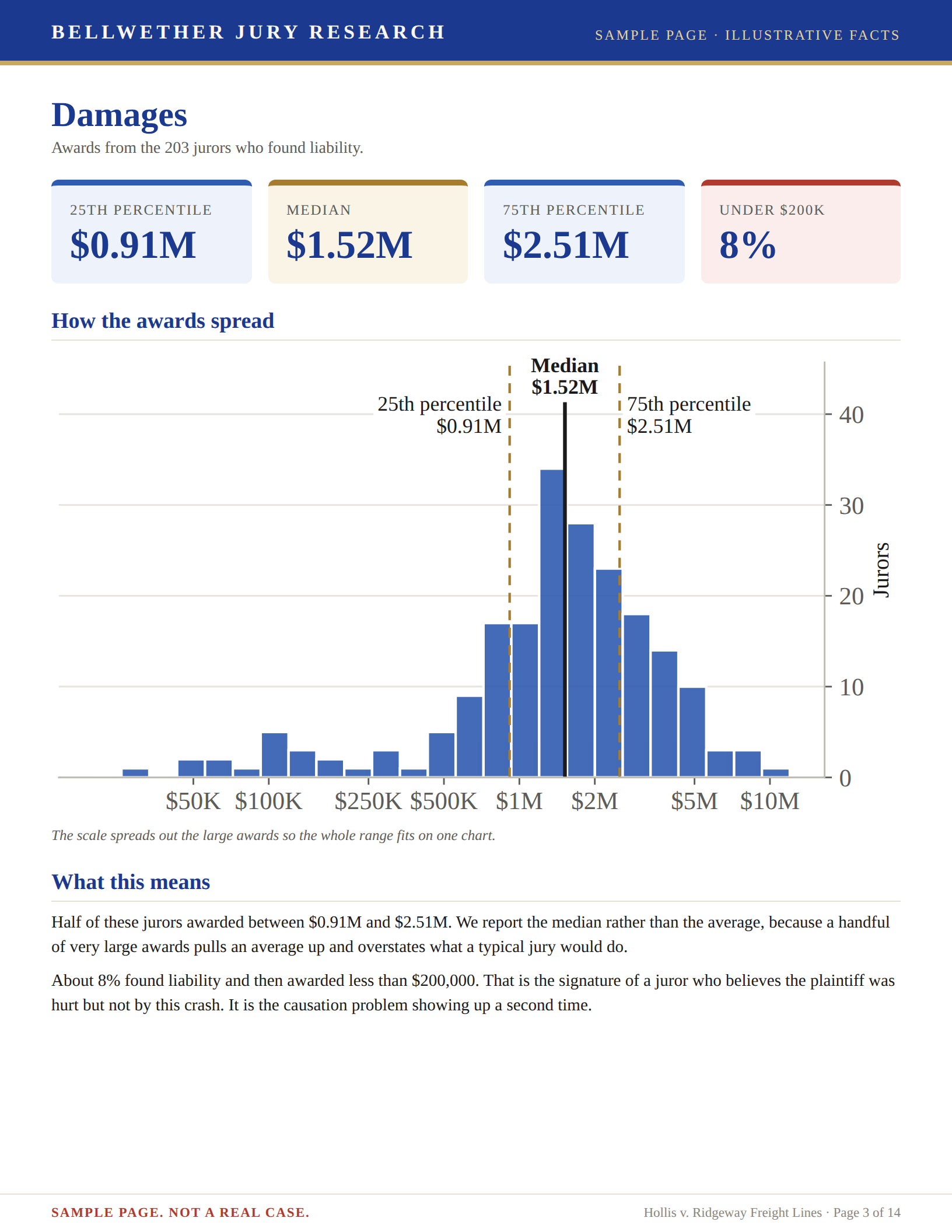
Sample Report Pages (click to enlarge)
What's wrong with other online jury surveys?
Some online jury research has recruited its "jurors" from Amazon Mechanical Turk, a marketplace built for small paid tasks. Researchers have spent years documenting what that does to data quality.
Most responses can fail basic checks. In one published study, only 14 of 529 Mechanical Turk responses survived the researchers' quality screens, which is 2.6 percent. Another study estimated that 33 to 46 percent of Mechanical Turk workers used ChatGPT or a similar tool to complete the task. Similarly, a 2025 study of more than 1,300 Mechanical Turk workers found that most of the general pool failed attention checks and gave inconsistent answers.
Sources: Too Good to Be True: Bots and Bad Data From Mechanical Turk, Perspectives on Psychological Science 19(6), 887-890 (2024); Artificial Artificial Artificial Intelligence, arXiv 2306.07899 (2023); Assessing the quality and reliability of the Amazon Mechanical Turk (MTurk) data in 2024, Royal Society Open Science 12(7) (2025).
Why AI cannot stand in for a jury
Some jury research now uses artificial intelligence in place of people. The software is told to act as three hundred jurors or more and report how they would vote. It cannot do that job.
AI predicts by matching patterns in data it has already seen. To predict a verdict it would need thousands of past cases showing everything each jury saw and heard and what that jury decided. That record does not exist. Verdicts are public, but the evidence behind them mostly is not.
Your case has never happened before. Your witnesses, your facts and your county have never come together in any case the software could have studied.
There is also no way to check the answer. A trial happens once. Nobody can try the same case again before a second jury to see whether the prediction was right, so the accuracy of an AI jury can never be measured.
The numbers fail too. We can give you a valid range because three hundred different people answer on their own. An AI program answering three hundred times is one opinion repeated. It has no real margin of error because it is not a sample.
AI has also never lived in your county. It has never sat in a doctor's waiting room or driven next to a semi on the expressway. Real jurors bring that experience into the jury room, and it decides verdicts. Bellwether asks real people from your county.
What's wrong with 12 person focus groups?
The sample size is too small.
Flip a coin 12 times. You get heads 8 times, 2/3 of the flips. Is the coin biased? You do not know. With only 12, the true rate could be anywhere from 35% to 90%. 50% is in that range.
Now flip it 300 times. You get heads 200 times, the same 2/3. Is the coin biased? Yes. With 300 flips, the true rate is between 61% and 72%. 50% is nowhere in that range.
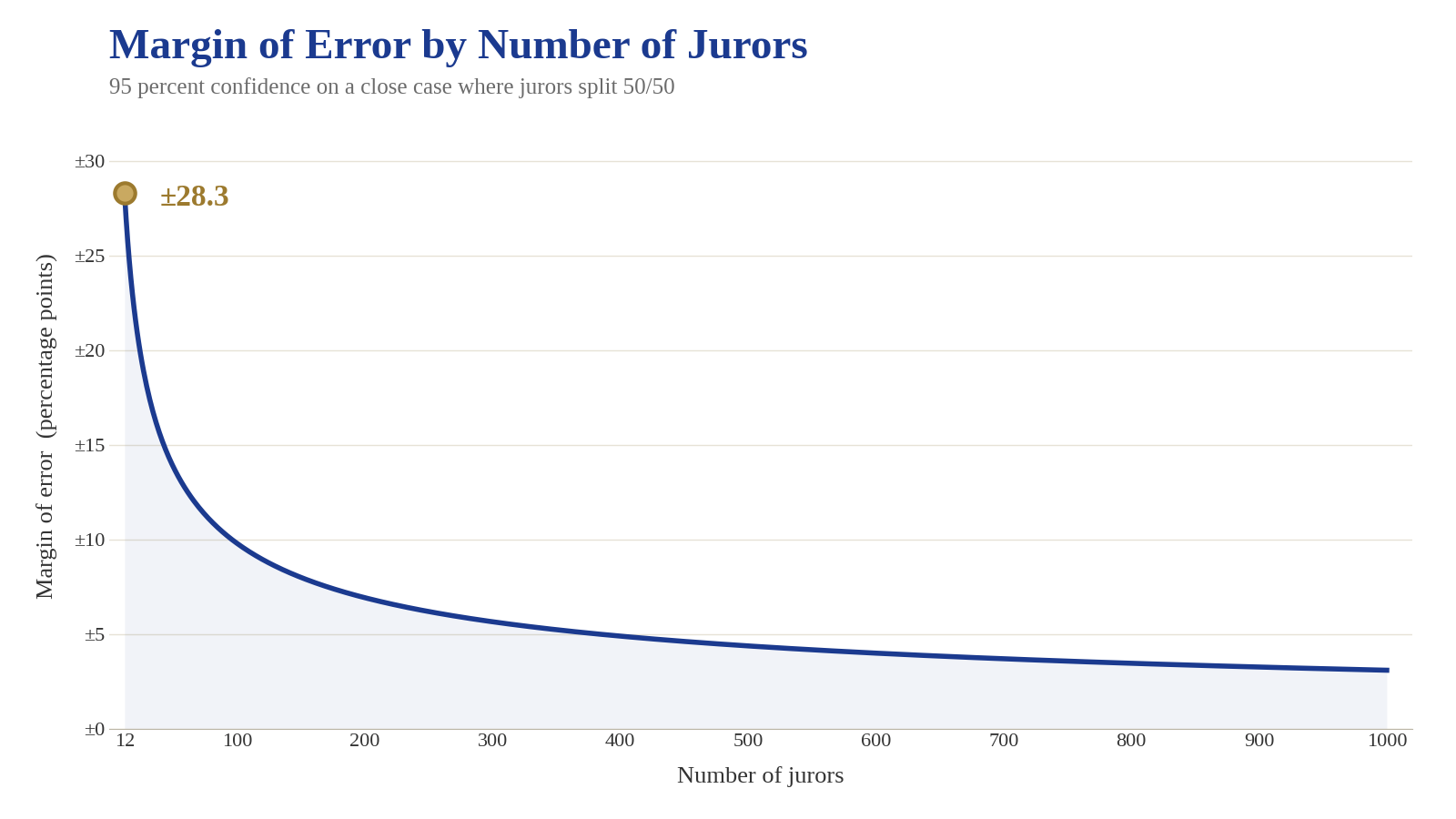
A focus group is twelve flips. One person in that room is 8.3 percent of your sample, so one person changing his mind swings the result by more than eight points. In a study of 300 jurors the same person moves it by only a third of a point. That is why you need a large sample.
Recruiting makes it worse. Those twelve were selected by a consultant, not drawn at random from the county where you will try the case. Adding people to a badly drawn sample does not fix it.
Why Big Data Has Big Limits
More and more jurors sounds better. The math says it matters less than you think. Each added juror buys less accuracy than the one before. Going from 12 jurors to 100 cuts the margin of error by more than 18 points.
Going from 300 jurors to 400 cuts it by less than one point and adds a third to the cost of jurors. Going from 300 to 500 cuts it by about one point and adds two thirds to the cost. Going from 300 to 1,000 cuts it by less than 3 points and more than triples what you pay for jurors. You would pay for 700 more jurors to gain less than 3 points.
What You Get
A fourteen + page report
you will actually read including:
The summary. Odds of winning on liability and how far off that number could be. How much fault jurors put on your client. What a jury will likely award and the range.
Liability, element by element. Where you win jurors and where you lose them.
Damages. The middle and range jurors award. Add on damage module and we test to find the optimal amount to ask for.
What moved the numbers. What facts your case turns on, which ones helped, which ones hurt and which did nothing.
What jurors remember. At the end of the case, jurors tell us in their own words what they remember most, then mark the key facts they recall from a list. You see which facts stick on their own and which only work when someone points them out.
Themes that work. We test your themes and short phrases against each other and report which one moves jurors most.
How to try this case. The report closes with a plan. It covers what to lead with, which theme to use, which weak facts to get ahead of, and what to cut.
Jury profiles. What average jurors said in their own words. What kinds of jurors help or hurt most. What jurors want to see that you didn't show them.
What to change. Recommendations on reframing the case, testing other elements, changing arguments or evidence, themes that work, addressing weak spots.
Report Uses. Case valuation and preparation, settlement or mediation with solid and proven numbers, fixing arguments before trial, knowing jurors to strike.
What we never do. Take percentage of case, make you call or negotiate a price, keep files or any communication after we finish (10 day destruction policy)

START YOUR STUDY
Tell us about your case
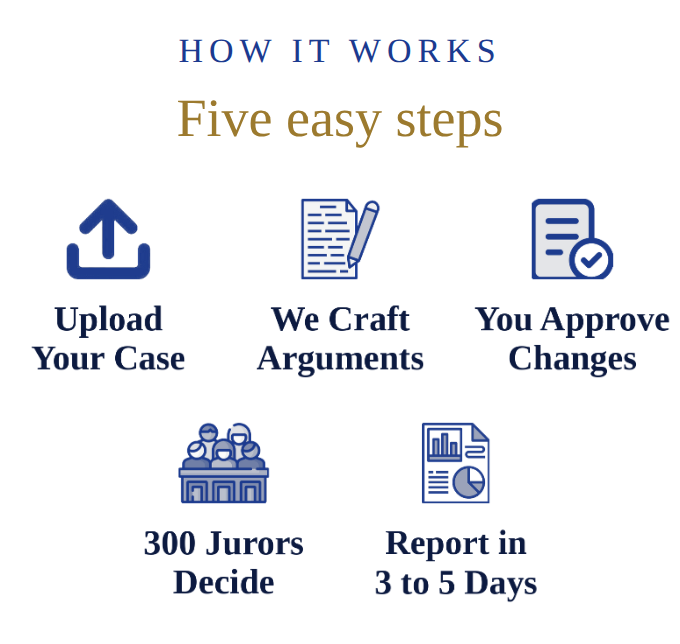
Mock jury studies decided by 300 real, jury-eligible people from your venue.
For plaintiff and defense attorneys who need to know how a jury will decide before trial. Detailed statistical report in 3 to 5 business days.

Size also cannot fix a bad sample. In 1936 the Literary Digest polled 2.4 million people and predicted Alf Landon would win with 57 percent of the vote. Franklin Roosevelt won 46 of the 48 states. George Gallup polled about 50,000 people and called it right. The Digest's respondents did not vote like the country. What matters is who answers the questions, and a larger group of the wrong people only makes the wrong answer look more certain.
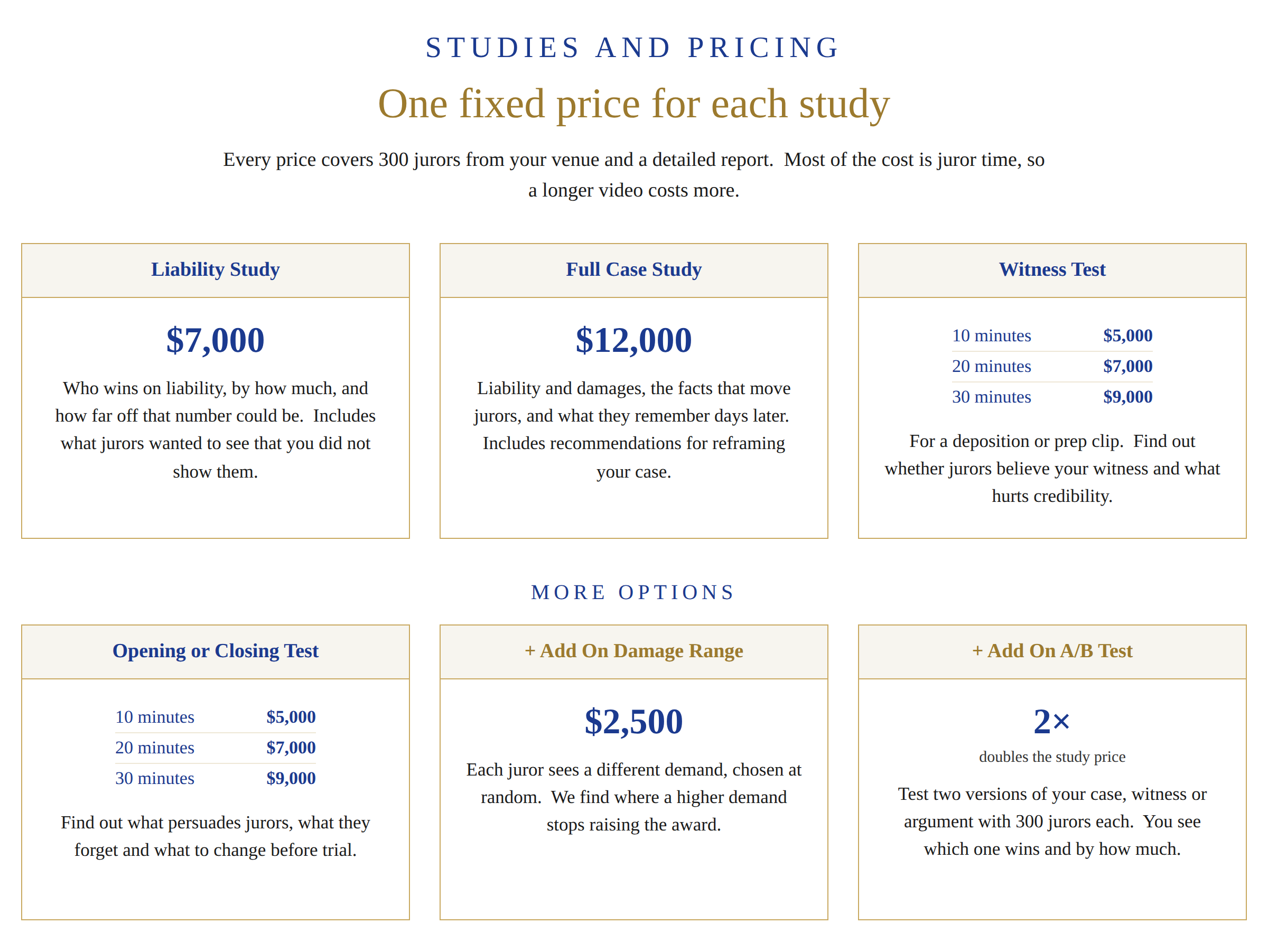
We chose 300 because it is the point where more jurors stop changing what the study tells you. At 300 the error from sample size is smaller than the uncertainty no study can remove. Paying for more would raise your price without changing your decision. Every study uses 300 jurors, who are real persons from your venue paid a market rate for their time. Juror pay is the largest line item you pay us.
Why Statisticians, not just attorneys or social scientists.
Every number is tested before you see it. Every Bellwether study is designed and analyzed using standard statistical methods.
Every number comes with its stastistally valid range and confidence interbal. We report what the jury will likely do and how far off that figure could be. You see “68 percent find liability, between 62 and 73 percent.”
When we compare two versions of an argument or two damage demands, jurors are assigned to each version at random. We then test whether the difference is larger than chance would produce. If it is not, we tell you so.
Quality checks on every juror. Jurors who rush, fail attention checks or give answers that contradict each other are removed before any number is calculated.
The method is in the report. Each report explains how every figure was reached, so you, a mediator or a client can follow it.